
The Pain Under the Ball of Your Foot Doesn’t Have to End Your Walks, Your Golf Game, or Your Pickleball.
Advanced, Non-Surgical Treatment for Plantar Plate Injuries — Serving Marble Falls and the Highland Lakes
You can feel it most when you push off. A deep, bruised ache under the ball of your foot — usually right behind the second toe, sometimes the third. It’s worse barefoot on tile or hardwood, worse in flat shoes, worse at the end of a day on the course or after a long walk around the lake. It feels like you’re stepping on a marble, or a folded sock, or a stone that isn’t there.
You’ve probably tried a metatarsal pad from the drugstore. Maybe a different pair of shoes. Maybe an arch support. Maybe just rest. Nothing has held. The pain keeps coming back to the same spot — and lately, it’s been showing up sooner in the day than it used to.
What you almost certainly have is a plantar plate injury — damage to the small ligament that supports the joint at the base of your toe. It is one of the most common forefoot conditions we see, and one of the most frequently missed. The good news is that plantar plate injuries respond exceptionally well to conservative care when they’re treated correctly and treated early. Surgery for this is an unsatisfactory late-stage answer to a problem that almost always has an early-stage solution.
The sooner we address this properly, the more likely it stays that way.
Medicare and most major insurance plans accepted.

Dr. Henry on Forefoot Pain
Trusted by Patients Across the Highland Lakes & Austin Area
“I’d had pain under the ball of my foot for almost a year. My primary doctor finally ordered an MRI, and it showed a tear in something called the plantar plate. The next thing I knew I was being scheduled to see a surgeon. A friend told me to see Dr. Henry first. He took one look at how my foot was loading, did a careful exam, and explained why an MRI tear doesn’t automatically mean an operation. Custom orthotics and a few months of his treatment plan, and I’m back walking three miles a day. I never had the surgery.”
— Carol M., Marble Falls“Two doctors told me I had a Morton’s neuroma and tried to inject the nerve. Both shots hurt more than they helped, and the pain just kept coming back to the same spot. Dr. Henry did an exam and an ultrasound on my first visit and showed me it wasn’t a nerve at all — it was the joint right next to it. Different problem, completely different treatment. The orthotics he made took the pressure off the joint, and the pain that had been there for two years was finally gone.”
— Linda B., Kingsland“I was scheduled for plantar plate surgery in Austin. My niece insisted I get a second opinion before going through with it, so I drove to Marble Falls to see Dr. Henry. He spent more time examining my foot than the surgeon had spent in the entire consultation. He showed me on his ultrasound exactly what was going on, explained why conservative care almost always works for this, and laid out a clear plan. I cancelled the surgery. Eighteen months later I’m walking the dog every morning and grateful I listened to my niece.”
— Diane R., Bee CaveWhy Your Second Toe Joint Won’t Stop Hurting
The Pain Is in the Joint. The Cause Is in How Your Foot Is Built and How It’s Loading.
To understand why your foot hurts, you have to understand what your foot is supposed to do. Your forefoot is built to share weight in a very specific way. The big toe joint — the first metatarsal — is designed to carry roughly half of the load coming through your forefoot. It’s the workhorse. The four smaller metatarsals behind the lesser toes are each designed to carry about one-eighth. That’s the architecture. That’s how the foot was built to work.
Now picture what happens when the big toe joint stops doing its job. That half of the load doesn’t disappear. It has to go somewhere — and it almost always lands on the joint right next to it: the second metatarsal. Suddenly the second joint isn’t carrying its designed one-eighth. It’s carrying its own one-eighth plus the half the first joint should have handled. Five-eighths of your forefoot weight, on a joint built for one-eighth.
The math doesn’t work. And the small ligament beneath that joint — the plantar plate — is what gives way first. That is the pain you’re feeling.
Three Reasons the First Joint Stops Doing Its Job
In our practice, almost every plantar plate injury we see traces back to one or more of three underlying causes. These are the things we look for during the exam, and these are the things that determine your treatment plan.
1. A hypermobile first ray.
Some people are simply born with a first metatarsal that moves too much. Instead of holding firm and carrying its share of weight, it gives way under load — and the second metatarsal is forced to pick up the slack. This is a structural issue, not something you caused, and it tends to run in families. Properly engineered orthotics can stabilize this.
2. Excessive pronation that destabilizes the forefoot.
When the rear of the foot rolls inward too far during walking — what you may have heard called overpronation or “flat feet” — the joints across the middle of the foot lose their ability to lock into a stable platform. The forefoot becomes a wobbly base instead of a firm one. Every step, the plantar plate beneath the second toe joint absorbs forces it was never built to handle. This pattern is one of the most common we see, and one of the most responsive to orthotic correction.
3. A first metatarsal that is anatomically too short, or a second that is anatomically too long.
On X-ray, we sometimes see a foot where the second metatarsal noticeably “sticks out” further than the first. When that happens, the second joint is the first part of the forefoot to hit the ground with each step — and it absorbs weight the first joint was supposed to handle. This is anatomy, not anything you did. We can’t change the bone, but we can change how the foot loads around it. And that changes everything.
When Bunion Surgery Causes the Same Problem
Some patients arrive with this exact pain after bunion surgery. The reason is mechanical. When a bunion is corrected — particularly if the first metatarsal is shortened or elevated as part of the procedure — the first joint can lose its ability to carry the half of the forefoot load it was designed for. That weight transfers to the second metatarsal head, and the plantar plate beneath it begins to break down exactly the way it would in someone born with a hypermobile first ray.
This is one of the patterns that surgical bunion correction can leave behind. The good news: the same conservative protocol that works for an unoperated foot also works here. The orthotic restores the load distribution the first joint can no longer provide on its own.
What Happens If This Isn’t Addressed
Plantar plate injuries don’t stay still. They progress. And in our experience, they progress along one of two paths — both of which take you out of the conservative window.
Path one: the joint loses stability. As the ligament continues to break down under the same loading pattern, the joint can no longer hold the toe in place. The second toe begins to drift — first medially, eventually upward — until at the late stages it lifts away from the ground entirely. Patients describe this as their toe “floating.” By the time a toe is floating, the conservative window has closed and surgery becomes the more realistic option.
Path two: the bone gives way before the ligament does. When that one joint is carrying five-eighths of your forefoot weight day after day, the bone itself eventually fails. We see metatarsal stress fractures — small breaks in the second metatarsal — in patients who pushed through this pain for too long. And once a stress fracture has occurred, the load redistributes again, often creating new pain at the third or fourth metatarsal head. That pattern is called a transfer lesion, and it is one of the most frustrating chains of foot pain we treat. One problem becomes two. Two becomes three.
This is the reason we treat plantar plate injuries aggressively in their earlier stages. The earlier you arrive, the more reliably this resolves without an operation — and without becoming the next problem down the chain.
A Word About MRIs and Plantar Plate Tears
A growing number of patients arrive at our office having already had an MRI — sometimes ordered by a primary care doctor, sometimes by a surgeon. The report uses the word tear, and surgery has often already been recommended. If that’s where you are, here’s what you need to know.
An MRI tear is not the same as a surgical indication. This is one of the most important things to understand about plantar plate imaging — and it’s the conversation most patients never get.
Plantar plate “tears” are extremely common findings on MRI. They show up in patients with severe pain. They also show up in patients with mild pain. And they show up — frequently — in people with no foot pain at all. The imaging tells us what the tissue looks like. It does not tell us what’s driving your pain, how your foot is loading, or whether surgery is the right next step. That takes an actual examination.
The vast majority of plantar plate injuries we treat — including ones with clearly visible tears on imaging — respond to conservative care. Custom orthotics, properly engineered for your specific foot mechanics, address the load pattern that caused the tear in the first place. When the load pattern changes, the tissue gets a chance to settle. Most patients see meaningful improvement within weeks.
If a surgeon ordered an MRI before doing a thorough biomechanical evaluation, the conversation skipped the part that matters most. Get that part done first. If conservative care doesn’t work, the surgical option is still there. But for most patients, that conversation isn’t needed at all.
If you’ve been told you need plantar plate surgery, the next step is not the operating room. It’s an actual evaluation of how your foot is loading, why the tear happened in the first place, and what conservative care can do about it. We see patients in your exact situation every week — most of them walk out with a treatment plan that doesn’t involve surgery at all.
Why the Inserts, the Pads, and the “Comfort” Shoes Haven’t Worked
If you’ve already tried metatarsal pads, gel cushions, retail inserts from a kiosk, or shoes that promise to cushion the pain away — here’s the short version of why none of it stopped this.
Cushioning Makes This Worse, Not Better.
This is the part most patients have backwards.
When the ball of your foot hurts, it feels obvious that what you need is more padding under it. So you buy the pad. You buy the gel insole. You buy the shoes with the air-cushioned sole or the foam that promises to absorb every step. And here’s the part patients almost always tell us: the shoes feel great when I try them on, but my foot keeps getting worse anyway.
There’s a reason for that.
Stability is the opposite of cushioning. A foot in pain doesn’t need a softer surface to land on — it needs a more stable platform underneath it, holding the bones in the right position so the load goes where it’s supposed to go. Cushioning lets the foot collapse into the very position that caused the problem. The shoe feels comfortable in the store. The plantar plate keeps breaking down underneath it.
If you remember one thing from this page, remember this: comfort and correction are not the same thing. Most of what’s been sold to you as comfort has actually been making the underlying problem worse.
Why “Custom” Inserts From a Scan Still Don’t Work.
Even devices sold as custom usually fall short for plantar plate patients, and the reason is mechanical.
Most retail and even some medical providers take a digital scan of your foot while you’re standing on it. The problem is that when you’re standing, your foot is already in the collapsed, overloaded position that caused the pain. Capturing that position and turning it into a device just locks you into the same broken mechanics that hurt you in the first place.
We do it differently. We take a precision plaster mold of your foot held in its corrected, neutral position — off your weight, with the foot positioned exactly where it should be biomechanically, not where it ends up under load. The lab then digitally scans those molds and builds the orthotic from there. The result is a device that holds your foot in the position it was designed to be in — not the position it collapses into when gravity gets ahold of it.
That distinction is the entire reason a properly engineered orthotic works when nothing else has.
The Difference, Plainly.
Pads cushion. Comfort shoes pad. Inserts soften. None of them correct the problem.
A properly engineered orthotic is not a better cushion. It’s the opposite of a cushion. It restores the foot’s stability, gets the big toe joint carrying its share of the load again, and takes the weight off the joint that’s been carrying too much for too long. That is the difference between making a foot feel comfortable and actually fixing it.
A Direct Word About Steroid Injections — Just Don’t!
This is the part of the page where we have to be unusually direct. If a doctor offers to inject your second toe joint with a steroid, please read this section before you agree to proceed.
Cortisone injections should be avoided in the second toe joint. This is one of the strongest positions we hold in this practice, and it is grounded in clinical experience that has shaped the way we treat plantar plate injuries for decades.
Most patients still call them “cortisone shots.” Most aren’t actually cortisone anymore. They’re triamcinolone (Kenalog), methylprednisolone (Depo-Medrol), or dexamethasone (Decadron). All in the same drug family. All carry the same risk profile when injected into a joint that’s already structurally compromised by a plantar plate injury — and that risk profile is severe.
When you inject a steroid into a joint where the supporting ligament is already failing, the steroid further weakens the soft tissue that’s holding the joint together. We have personally seen second toe joints dislocate after a steroid injection in patients whose plantar plate was already compromised. Once that joint dislocates, it cannot be put back. Even surgery is unreliable. What was a manageable problem becomes a much harder one, almost overnight.
This is not theoretical. It is something we have watched happen, and it is the reason we do not use steroid injections in this joint.
What we use instead. When injection therapy is clinically indicated as part of the plantar plate treatment plan, we use advanced restorative injection therapy — a different category of treatment with a different mechanism and a different risk profile. It addresses the local environment around the joint without the catastrophic structural risk that comes with steroids in this specific location.
If a doctor offers you a steroid shot in your second toe joint and your plantar plate has already been damaged, please get a second opinion before you agree to it. We would much rather have a conversation with you before that appointment than after.
We see patients every month who arrive with a dislocated second toe joint after a single steroid injection. The injection seemed routine to the provider who gave it. The dislocation that followed was anything but. This is a category of harm that’s preventable — and the way to prevent it is to make sure no steroid gets injected into this joint in the first place.
A Complete Approach to Resolving Plantar Plate Pain
Every patient gets a treatment plan built around three pillars. The exact mix is calibrated to your foot, your loading pattern, and the severity of the injury — but the framework is consistent, and the order matters.
1. Confirm and Calm.
The first thing we do at your first visit is something most patients have never had: a properly placed diagnostic taping that takes the load off your second toe joint and lets us see how your foot responds. If the tape gives you immediate relief, that tells both of us something powerful — your pain is mechanical, and the conservative protocol is going to work.
For early-stage injuries, taping plus activity adjustment is usually enough to hold the joint quiet while we move into longer-term treatment. For more advanced or actively torn plantar plates, we bring in a CAM boot — typically two to four weeks — to fully immobilize the joint and break the cycle. Most patients hate the boot. We’re not thrilled about prescribing it either. But for the right injury at the right stage, it’s the cleanest way to give the tissue the rest it can’t get any other way.
2. Correct the Cause.
This is the central pillar. The plantar plate didn’t break down because of bad luck. It broke down because the load distribution across your forefoot was wrong — for years. Until that’s fixed, nothing else holds.
We take a precision plaster mold of your foot in its corrected, neutral position — off your weight, the way the foot was supposed to be built. The lab digitally scans those molds and fabricates an orthotic engineered specifically to do three things: restore the big toe joint’s ability to carry its share of the load, control the rearfoot motion that destabilizes your forefoot, and offload the second metatarsal head with the precision and contour your specific anatomy requires.
We pair the orthotic with footwear guidance — what to wear, what to throw out, and why the cushioned shoes you’ve been buying have likely been making this worse. Properly made medical orthotics last fifteen to twenty years. They are not a recurring expense. They are the foundation that makes the rest of the plan work.
3. Accelerate the Healing.
With the load distribution corrected and the joint protected, we bring in the tools that help the tissue itself recover. Class IV therapeutic laser reduces local inflammation and supports cellular repair at the site of injury — non-invasive, no downtime, no anesthesia.
Where clinically indicated, we may add advanced restorative injection therapy as part of a structured protocol. This is not a steroid injection (please see the warning above). It’s a different category of treatment, with a different mechanism, designed to address the local environment around the joint and support the tissue’s own healing response. We use it selectively — never as a standalone fix, always as part of the broader plan.
Most patients see meaningful improvement within the first few weeks. Lasting change typically takes a treatment cycle of two to three months. The plan is always honest, always grounded in what your specific foot will respond to, and always designed to keep you out of surgery.
Why Surgery Often Creates the Next Problem
Patients sometimes ask why we’re so committed to avoiding surgery for plantar plate injuries when surgery is a real option. The honest answer is twofold. First, conservative care simply works for most patients with this condition. Second — and this is the part most patients don’t hear before they consent — plantar plate surgery carries multiple specific risks: the surgery may not relieve the original pain, it can make the original pain worse, and it can create new pain in a different part of the same foot.
The traditional surgical approaches for plantar plate injuries involve metatarsal osteotomies — procedures that shorten, elevate, or otherwise reposition the bone to take pressure off the failing joint. The intent is sound. The problem is mechanical. When you change the geometry of one metatarsal, the load that was passing through it has to go somewhere. It almost always lands on the metatarsal next to it. The pain at the second joint resolves. New pain begins at the third. Sometimes the fourth. This pattern is called a transfer lesion — and it is one of the most frustrating chains of foot pain we treat.
We moved the problem. We didn’t solve it.
If the surgery is done and the underlying forefoot loading isn’t corrected, the surgery will fail. The same forces that broke down the original joint will go to work on the surgically reconstructed one. The bone heals. The mechanics don’t. Within months to a few years, the patient is back where they started — sometimes worse, often with a transfer lesion right next door.
This is why, in the rare case we do refer a patient for plantar plate surgery, we make sure they already have properly engineered orthotics in place before the operation. The orthotic protects the surgical result. Without it, the surgery has no chance of holding.
But here’s the part worth thinking about: those are the same orthotics that would have prevented the need for surgery in the first place.
So the real question isn’t “orthotic or surgery?” The real question is: do you want the orthotic alone — or the orthotic plus the surgery, plus the recovery, plus the cost, plus the transfer-lesion risk, plus everything else surgery brings? Because either way, the orthotic is part of the answer.
The orthotic is the foundation. With it, most plantar plate injuries resolve without surgery. Without it, surgery doesn’t hold. That’s the actual choice.
This isn’t theoretical. We see patients in our office every month who had plantar plate surgery somewhere else, were never given an orthotic before or after, and have now arrived at our door because the surgery failed. We put them into properly engineered orthotics — because the underlying mechanics still need to be corrected, surgery or no surgery. And almost every one of these patients says some version of the same thing: I wish I’d done the orthotics first. I could have skipped the surgery entirely — and I wouldn’t be sitting here now dealing with the surgery that failed on top of the original problem.
Two things could have been avoided. The surgery itself, and the surgery’s failure. Both were prevented by the same device, applied at the right time.
This is one of the reasons our practice is built around conservative care for plantar plate injuries. But it isn’t the main reason. The main reason is that conservative care, properly done, simply works for the vast majority of patients with this condition. When surgery genuinely is the right answer — and for a small number of patients, it is — we’ll tell you that directly, make sure the orthotic foundation is in place first, and refer you to the surgeon best suited for the procedure.
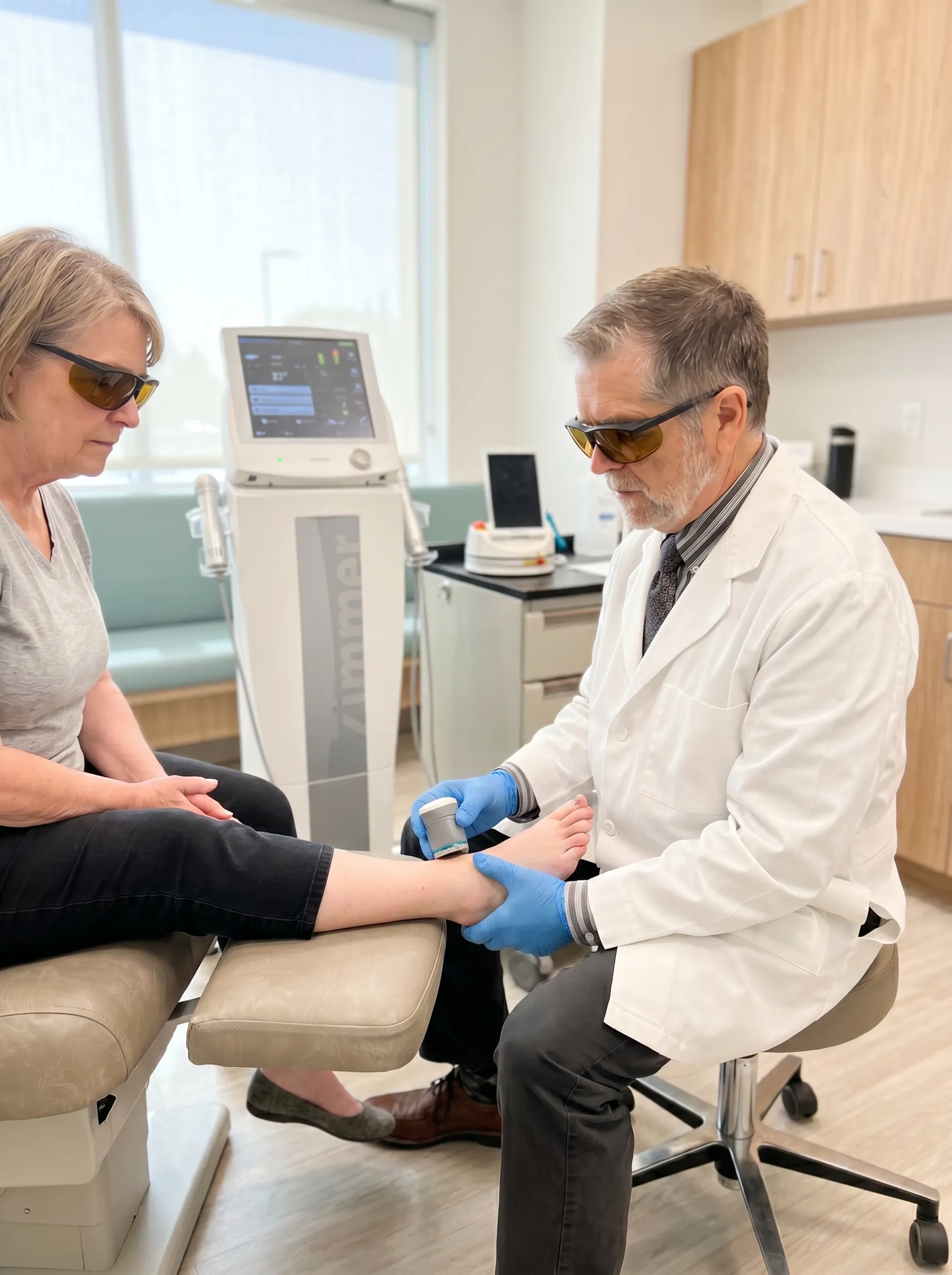
Meet Dr. Frank J. Henry, DPM, FACFAS
“Most patients walk in expecting to be told they need surgery. Most walk out with a treatment plan that doesn’t involve one. The orthotic does the heavy lifting. The body does the rest.”
Dr. Henry has been in practice for more than thirty years — the past eight serving the Highland Lakes and Hill Country, after a long-established practice in South Texas. He is a board-certified foot and ankle surgeon, certified since 1990, with full unrestricted scope including forefoot, rearfoot, and ankle. He has personally treated more than 40,000 patients across his career.
He studied biomechanics directly under the founders of modern foot and ankle biomechanics — Drs. Root, Weed, Orien, and Sgarlato — and built his entire clinical practice around the principle that most foot and ankle pain has a mechanical root cause that can be identified and treated without surgery. Approximately 95% of the patients who walk into this practice are successfully treated without an operation.
Today, Dr. Henry uses his extensive surgical background to do the opposite of what many specialists do — he keeps patients out of the operating room. Plantar plate injuries are one of the conditions he sees most frequently, and one of the most reliably resolved without surgery when the underlying mechanics are properly corrected. You’ll never feel rushed in his office. You’ll get a real evaluation, a real explanation, and a real plan.
What to Expect at Your First Visit
We know how frustrating rushed, ten-minute appointments can be. Your first visit with us is different. Plan on about an hour.
- A thorough, unhurried evaluation. We sit down with you, listen carefully to your history, and take the time to understand exactly how the pain is affecting your daily life — and what you’ve stopped doing because of it.
- Live diagnostic ultrasound of the joint and ligament. Musculoskeletal ultrasound lets us look at your plantar plate and the surrounding joint structures in real time, right in the exam room. We can see exactly where the damage is, how severe it is, and whether the surrounding tissues are involved — no waiting, no separate imaging appointment, no radiologist’s report days later.
- In-office digital X-rays of the affected foot. We review them with you on-screen so you can see exactly what’s there — including the relationship between your first and second metatarsals, which is often the structural piece of the puzzle that hasn’t been explained to you yet.
- The diagnostic taping test. We perform a properly placed taping that takes the load off the second toe joint. If this gives you immediate relief, it confirms — for both of us — that your pain is mechanical, and that the conservative protocol is going to work. This single in-office test is one of the most reliable predictors we have of long-term success.
- A clear plan and honest pricing — before any treatment begins. We outline your options at your first visit. At your follow-up, we review how your foot responded to the taping test, walk you through your exact treatment plan, and give you a complete breakdown of costs. You’ll never be asked to commit to treatment without knowing what it involves or what it costs.
- Honest answers about whether surgery is or isn’t on the table. In the rare case it is, you’ll know why. In the much more common case it isn’t, you’ll know that too — and you’ll know exactly what we’re going to do instead.
Common Questions About Plantar Plate Pain
I have an MRI showing a plantar plate tear. Doesn’t that mean I need surgery?
Not in the great majority of cases. Plantar plate “tears” are extremely common findings on MRI — they show up in patients with severe pain, in patients with mild pain, and in people with no foot pain at all. The imaging tells us what the tissue looks like. It does not tell us what’s driving your pain or whether surgery is the right next step. The vast majority of plantar plate injuries we treat — including ones with clearly visible tears on imaging — respond to conservative care. If a surgical recommendation has already followed your MRI, a second opinion is the right next step before you agree to anything.
How is this different from a Morton’s neuroma?
Morton’s neuroma is a nerve problem — irritation and thickening of one of the small nerves that runs between your metatarsal heads. The pain often feels like burning, tingling, or a sharp electric sensation, and it’s most commonly between the third and fourth toes. Plantar plate injuries are joint-and-ligament problems — the pain is usually a deeper ache directly under the second toe joint, often described as feeling like you’re stepping on a marble or a folded sock. The two are frequently confused, and they are commonly mistreated for each other. A proper exam — particularly with diagnostic ultrasound — distinguishes them quickly.
Can a plantar plate tear actually heal, or is it permanent damage?
The right way to answer this is to reframe the question. Whether the tear itself completely “heals” on imaging is less important than whether the joint stops hurting and stays stable for the long term. With proper offloading — especially through correctly engineered orthotics — most plantar plate injuries become functionally asymptomatic. The tear may remain visible on imaging, but the patient is back to walking, hiking, golfing, or doing whatever they want to do, without pain. That’s the practical definition of a good outcome, and that’s what most of our patients achieve.
Why didn’t my over-the-counter metatarsal pad or my drugstore inserts work?
Cushioning and correction are not the same thing. Pads and inserts are designed to soften the moment of impact — they don’t redistribute the load that’s actually breaking down your plantar plate. The pain comes from the second metatarsal carrying weight that the first metatarsal should be carrying. Until that load distribution is corrected at the source, no amount of padding under the painful joint will hold. A properly engineered orthotic doesn’t cushion. It corrects. That’s why it works when nothing else has.
My doctor offered me a cortisone shot in this joint. Is that a problem?
Yes — and it’s important enough that we wrote a separate section on this page about it (please see “A Direct Word About Steroid Injections — Just Don’t!” above). When the supporting ligament of the second toe joint is already compromised by a plantar plate injury, a steroid injection further weakens the soft tissues holding the joint together. We have personally seen second toe joints dislocate after steroid injections in this situation. Once that joint dislocates, it cannot be put back, and even surgery is unreliable. This is one of the situations where a second opinion before you proceed could prevent a much harder problem.
My second toe is starting to lift up off the ground. Is it too late for conservative care?
It depends on how far along the process is. A toe that is just beginning to drift can sometimes be stabilized with proper orthotic correction and activity modification — particularly if the underlying biomechanics are addressed promptly. A toe that is fully floating, with significant displacement, has typically passed the conservative window. The honest answer is that this is exactly the kind of situation where a thorough in-office evaluation matters more than guesswork. Come in. We’ll tell you the truth about where you actually stand.
Can my teenager get this? My son has been complaining about pain in the same area.
Yes, although it presents somewhat differently in younger patients. The same biomechanical patterns that drive plantar plate injuries in adults — particularly excessive pronation and forefoot overload — can affect adolescents and active teenagers. In younger patients, similar pain in the same location sometimes turns out to be a related condition called Freiberg’s infraction, where the bone in the second metatarsal head itself is affected. The clinical picture is similar, the conservative approach is similar, and most adolescent patients respond well to orthotic therapy and a period of activity modification, sometimes including a CAM boot for rest. If your teenager is describing this kind of pain, don’t wait it out. Have it looked at.
Will I be able to walk, hike, golf, and play pickleball again?
For the vast majority of our patients with plantar plate injuries, the honest answer is yes. The goal of every treatment plan we build is full return to the activities you love. The earlier we start, the cleaner the timeline — but even patients who arrive with longstanding plantar plate pain typically get back to their full activity level within a few months of starting the proper protocol. We’ll be straight with you about your specific timeline at your first visit.
Do you accept Medicare and insurance?
Yes. We accept Medicare and most major insurance plans. Our team is happy to verify your benefits before your first appointment — just call (830) 265-6000.