
You’ve Been Told You Need Surgery. But Maybe You Don’t. You Owe Yourself a Second Opinion.
Honest Surgical Evaluation from a Board-Certified Foot and Ankle Surgeon — Serving Austin and the Highland Lakes
You walked out of that appointment knowing what was coming. The recovery time. The weeks in the boot or the cast. The risk that things wouldn’t quite work the way they did before. The friends who’ve already had a similar surgery and were ready to tell you what to expect. You went home and started rearranging your life around it.
And then something didn’t sit right. Maybe the doctor talked at length about the benefits of the surgery but barely mentioned the downsides — the recovery time, the things that can go wrong, the fact that some patients don’t end up better than they started. Maybe the whole recommendation came after a fifteen-minute appointment in which no one ever really examined how you walked, how your foot loads, or what conservative care had actually been tried. Maybe no one even touched your foot — the whole appointment was someone looking at a computer monitor.
That doubt is worth listening to. Before you schedule the operation, get a real second opinion from a board-certified foot and ankle surgeon — one whose entire practice is built around keeping people out of the operating room. We do this every week — and most of the time, the answer is no, you don’t need it.
Medicare and most major insurance plans accepted.

Before You Schedule the Surgery
Patients Who Came for a Second Opinion
“An orthopedic surgeon in Austin told me I needed bunion surgery on both feet and quoted me three months of recovery — six months total if I did them one at a time. I drove out to Marble Falls for a second opinion because something didn’t feel right. Dr. Henry watched me walk, examined both feet, took the time to actually understand what was happening, and put me in custom orthotics with a treatment plan that didn’t involve cutting bone. Two years later my bunions look about the same on X-ray, but the pain is gone and I’m walking 8,000 steps a day. I never had the surgery. I never needed to.”
— Susan M., Lakeway“The MRI showed a partial tear in my posterior tibial tendon and the surgeon I was referred to said I needed it repaired. He didn’t really examine me — he just looked at the screen and told me what was going to happen next. My daughter convinced me to get a second opinion. Dr. Henry did his own ultrasound right there in the office, watched the tendon work in real time as I moved my foot, and explained that the ‘tear’ wasn’t what was actually causing my pain. The pain was mechanical, and it could be fixed without surgery. He was right. I’m back to walking the trails at Inks Lake and I’m grateful every single day.”
— Carolyn D., Burnet“Two different orthopedic groups in Austin told me my ankle arthritis was bad enough that I needed a fusion. One of them told me I should do it sooner rather than later because it was ‘only going to get worse.’ I’m 71 years old. The thought of major ankle surgery and the recovery terrified me. A friend told me to call Dr. Henry. He spent almost an hour with me — looked at my X-rays, examined how I walked, did an ultrasound, and explained that there was a real conservative path I hadn’t been offered. That was three years ago. I’m still walking. I’m still doing what I want to do. And I haven’t had the operation.”
— Dorothy K., Cedar ParkSurgical Recommendations We Independently Evaluate
These are the most common surgical recommendations we see in second-opinion patients — and the conservative paths that work for most of them.
Bunion Surgery
Recommended bunionectomy or osteotomy? Most of the patients we see in second opinion respond to conservative care that addresses the foot mechanics driving the deformity — without ever stepping into the operating room.
Learn More →Plantar Fasciitis & Heel Spurs
Recommended endoscopic plantar fasciotomy or heel spur removal? The vast majority of chronic heel pain resolves with proper biomechanical correction, shockwave, and laser therapy. Surgery is rarely the right first answer.
Learn More →Tendon Tears on MRI
Recommended tendon repair after an MRI showed a tear? Imaging frequently reveals tendon tears that are not, by themselves, the source of pain — or even the source of any pain at all. Achilles, peroneal, and posterior tibial linear tears commonly respond to conservative care without surgical repair.
Learn More →Foot & Ankle Arthritis
Told you need fusion, joint replacement, or cheilectomy? Most arthritis pain — including cases at the threshold of surgical recommendation — responds to a properly engineered conservative protocol that addresses joint loading, inflammation, and biomechanical compensation.
Learn More →Morton’s Neuroma
Recommended neuroma excision? Most neuroma patients respond to advanced restorative injection therapy, custom orthotic offloading, and footwear modification. Removing the nerve is rarely the right first answer.
Learn More →PTTD / Flatfoot Reconstruction
Recommended flatfoot reconstruction or posterior tibial tendon repair? Most early and moderate cases respond to proper bracing, custom orthotics, and conservative protocols. Surgical reconstruction is rarely the right first answer.
Learn More →Tarsal Tunnel Syndrome
Recommended tarsal tunnel release? Most cases are mechanical compression that resolves with proper biomechanical management. Surgical release should be a last option, not a first.
Learn More →Plantar Plate Tear Repair
Told you need plantar plate repair after an MRI showed a tear? Most plantar plate tears respond to taping, properly engineered orthotics, and footwear modification. Surgical repair is rarely the right first answer.
Learn More →Why You’re Hearing What You’re Hearing
Most foot and ankle surgical recommendations come from orthopedic and podiatric surgeons. Both are highly trained, both are skilled at what they do, and when surgery is genuinely the right answer, both are the right people for the job.
But surgical training, in both specialties, is built around procedures. There’s an old saying in medicine: if the only tool you have is a hammer, everything looks like a nail. Most of my colleagues have either forgotten their other tools or never got them in the first place.
The conservative tools my colleagues have lost — engineered offloading, restorative therapies, detailed gait and structural evaluation that takes time and doesn’t fit how the system is reimbursed — have been steadily pushed out of surgical training and continuing education over the last generation. A foot or ankle problem walks into either kind of office today and is evaluated through a surgical lens, because that’s the lens both specialties have been trained to use.
Underneath the training is a structural reality: the system pays for surgery. Surgical reimbursements are substantial; conservative evaluations are not. Hospitals and surgical centers are organized around operating room throughput, and many surgeons and surgical groups have ownership interests in the surgery centers themselves. None of this is corrupt — it’s how the system is structured. But it’s worth understanding before you accept a surgical recommendation as the only path forward.
When the surgeon evaluating you isn’t going to perform the surgery and won’t financially benefit from your having it, the recommendation you receive is structurally honest. If we tell you that you genuinely do need surgery, we’ll refer you to the surgeon best suited for your specific operation. In most cases, that’s the surgeon who recommended it to begin with. And if we tell you that you don’t need it — that’s also worth knowing before you sign anything.
What the MRI (or X-Ray) Actually Shows, and What It Doesn’t
You went in for the imaging. The report came back. The radiologist mentioned a tear, or a spur, or joint changes. The surgeon scheduled the procedure. You assumed that was that — the picture showed the problem, and the problem needed to be fixed.
Here’s what most patients are never told: imaging is sensitive but not specific. It’s extraordinarily good at showing what’s there. It’s much less good at telling us whether what’s there is actually causing your pain.
A small example we see almost every week. Most heel-pain patients come in with a heel spur on the X-ray of the painful foot. We routinely image both feet for comparison — and very often there’s a heel spur on the other foot too, the one that doesn’t hurt at all. Same patient, same body, same spurs, but only one foot is symptomatic.
Years ago, before high-resolution ultrasound and MRI, the profession used to surgically remove heel spurs. Surgeons were genuinely puzzled when patients still had pain after the procedure. It took the field a long time to appreciate that the pain wasn’t coming from the spur — the pain was coming from the plantar fascia, and the spur was incidental. Patients were having operations they didn’t need on a structure that wasn’t the problem.
Would you want surgery on your other foot just because there’s a spur on the imaging?
The same principle applies to tendons. Studies of pain-free populations have shown surprisingly high rates of MRI tendon abnormalities in people who feel completely fine — small tears, signal changes, partial fissures that don’t hurt anyone and never will. What matters isn’t whether the imaging shows something. What matters is whether what it shows is the actual source of the pain — and that question is answered by physical examination, by dynamic ultrasound that watches the tendon work in real time under load, and by correlating findings with how you actually feel and function. A static MRI can’t do that. Only a thorough clinical evaluation can.
There are honest exceptions, and we’ll always tell you when we see one. A complete Achilles rupture in an active patient is a real surgical question — when we see one, we typically refer to a surgeon. A few specific tear patterns and severity grades genuinely do warrant repair. But the great majority of “tears” we see in second-opinion patients — Achilles, peroneal, posterior tibial, plantar plate — are not, by themselves, a surgical indication. They’re imaging findings that need to be correlated with everything else.
If you’re being told you need surgery primarily because of what an MRI showed, that’s the conversation worth having before you schedule it.
Meet Dr. Frank J. Henry, DPM, FACFAS
Dr. Henry has been in practice for more than thirty years — the past eight serving the Highland Lakes and Hill Country, after a long-established practice in South Texas. He is a board-certified foot and ankle surgeon and foot & ankle specialist, certified since 1990, with full unrestricted scope including forefoot, rearfoot, and ankle. He has personally treated more than 40,000 patients across his career.
He studied biomechanics directly under the founders of modern foot and ankle biomechanics and built his entire clinical practice around the principle that most foot and ankle pain has a mechanical root cause that can be identified and treated without surgery. Approximately 95% of the patients who walk into this practice are successfully treated without an operation.
What to Expect at Your Second-Opinion Visit
A second-opinion visit looks different from a first-visit consultation for a new condition. You already know what you’ve been told. What you need is a thorough, independent evaluation of whether the recommendation you received holds up. Plan on about an hour.
- A full review of what you’ve already been told. Bring the operative recommendation, any imaging reports, such as X-rays or MRI , and any notes from the consulting surgeon. We’ll review what was found, what was concluded, and how the recommendation was made.
- A complete biomechanical evaluation. We look at how you stand, how you walk, how the affected foot loads under weight, and how the surrounding structures are compensating. This is the part of the evaluation that’s most often missing from a surgical consult.
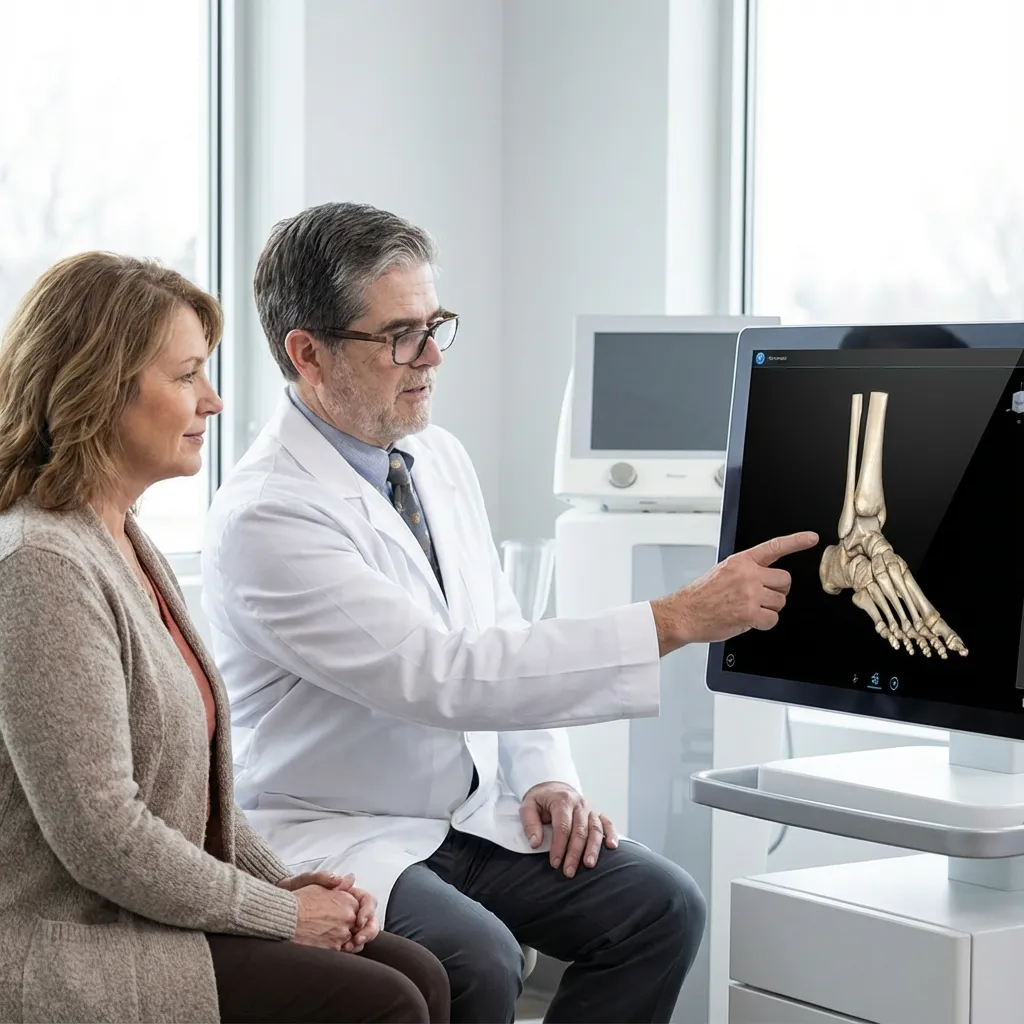
- In-office digital X-rays of both feet, reviewed with you on-screen. We image bilaterally for comparison — what the symptomatic foot shows versus what the asymptomatic foot shows. This often changes the interpretation of imaging findings significantly.
- Live diagnostic ultrasound where indicated. Dynamic ultrasound watches tendons and soft tissue work in real time as you move your foot. It shows things a static MRI cannot — what the structure is actually doing under load, not just what it looks like at rest.
- An orthopedic strapping or taping test. Modest relief from taping is a reliable predictor that proper biomechanical correction will resolve the underlying problem without surgery. It’s a diagnostic, not a treatment — it gives us a reliable indication whether the conservative path is going to work for you.
- An honest, spoken assessment. We’ll tell you directly what we found, whether we agree with the surgical recommendation, and what the realistic conservative path looks like if there is one. If we think you genuinely do need the operation, we’ll say so — and we’ll help you make sure it’s the right surgeon for the specific procedure.
You’ll leave with a clear understanding of where you actually stand and what your realistic options are — before you make a decision you can’t easily undo.
Common Questions About Foot and Ankle Surgery Second Opinions
Will the original surgeon find out I came for a second opinion?
Not unless you choose to tell them. A second opinion is your right as a patient, and getting one is a normal part of medical decision-making — especially before an operation. Most surgeons themselves recommend second opinions for any major procedure. We don’t contact the original surgeon, send them notes, or report back to them in any way. If we agree with their recommendation and you decide to proceed, we’ll usually refer you back to that surgeon, but the choice of whether to tell them you got a second opinion is entirely yours.
How is a second-opinion visit different from a regular consultation?
The structure is different because the question is different. A regular consultation asks what’s wrong, and what should we do about it. A second-opinion visit asks does the recommendation you’ve already received hold up under independent evaluation. That changes how we approach the visit. We review the imaging you bring, we re-evaluate the clinical findings, we look at how the recommendation was made, and we tell you directly whether it stands up — or whether there’s a conservative path that wasn’t offered. The visit is about the recommendation, not just the condition.
What should I bring to my second-opinion visit?
Whatever documentation you have. The operative recommendation in writing if you have it, any imaging reports (MRI, X-ray, ultrasound), and any notes or letters from the consulting surgeon. If you only have the verbal recommendation and no written documentation, that’s fine too — just bring what you have. We’ll work with whatever you bring and order new imaging in-office if we need to.
Also bring your everyday shoes and any inserts or orthotics you’ve tried. They tell us a lot about your day-to-day mechanics and about what’s already been attempted — and they’re often as informative as the imaging.
What if you agree I do need surgery?
We’ll tell you directly, and we’ll help you make sure you have the right surgeon for your specific operation. In most cases, that’s the surgeon who recommended it to begin with — they’ve already evaluated you, the imaging is on file, and there’s no benefit to starting over. Occasionally we’ll suggest a different surgeon if your specific procedure isn’t that surgeon’s primary specialty. Either way, you’ll leave the visit knowing whether to proceed and with whom.
What if my surgeon told me it has to be done soon, and a second opinion will delay things?
Most foot and ankle conditions that get referred for elective surgery are not time-critical. Bunions, arthritis, plantar fasciitis, and most tendon problems develop over months and years — a two- or three-week delay to get a careful second opinion does not change the outcome. There are genuine surgical emergencies in foot and ankle care, but they are rare, and your surgeon would not be scheduling a routine appointment if you were in that category. If a recommendation came with significant urgency attached, that’s worth understanding — but it’s almost never a reason to skip a second opinion.
Do you accept Medicare and insurance for second-opinion visits?
Yes. We accept Medicare and most major insurance plans, and second-opinion visits are reimbursable in the same way as any other consultation. Our team will verify your benefits before your appointment — call (830) 265-6000 if you’d like to confirm coverage in advance.