
Finally, Clear Your Fungal Toenails — Laser Treatment That Works Where Pills and Creams Fail
Advanced, Non-Surgical Laser Treatment for Fungal Toenails — Serving Marble Falls and Highland Lakes
You know the feeling. Closed-toe shoes in August when everyone else at the lake is in sandals. Painting over thick, yellow nails, knowing polish only hides what’s underneath. Pharmacy creams that never quite reach the problem. And the quiet, nagging worry that the only “real” fix is a pill your doctor told you could hurt your liver.
You don’t have to hide them. And you don’t have to risk your liver to clear them.
or call (830) 265-6000 to speak with our team directly
Your evaluation visit is billed to insurance. The laser protocol itself is self-pay.
- 30+ Years of Experience
- 40,000+ Patients Treated
- Board-Certified Foot & Ankle Surgeon
“Three summers without sandals. I’d tried every cream, every home remedy in the book. Six weeks into Dr. Henry’s protocol my big toe has clear nail growing in for the first time in years.”
— Denise R., Kingsland
“My family doctor told me it was just aging nails and I should learn to live with it. Dr. Henry confirmed the infection on the first visit and actually explained what it takes to clear it. Wish I’d come here years ago.”
— Margaret W., Lakeway
“I drove to Austin for a single laser session at another clinic. They charged me, sent me home, and the nails never improved. Dr. Henry’s three-session protocol is actually working. Completely different approach.”
— Carol M., Bee Cave
Why Fungal Nails Keep Coming Back — And Why “Just Trimming Them” Isn’t Enough
Fungal nails aren’t a surface problem. The infection lives deep — underneath the nail, embedded in the nail bed, protected by layers of thickened, hardened tissue. That’s why trimming the surface doesn’t stop it. That’s why the thick, yellow nail you filed down last week grew back looking exactly the same.
Left alone, fungal infections don’t stay in one nail. They spread — nail to nail, to the skin around your feet, sometimes to other family members who share the same shower. And worse: as the infection works its way back toward the nail root, it can permanently damage the nail-growing tissue itself. Patients who wait too long can end up with nails that stay thick and deformed even after every bit of fungus is gone. Years ago, before we had effective laser treatment, the only answer for those advanced cases was permanent nail removal. That’s the window we’re trying to keep you out of.
There’s one more reason fungal nails don’t get better on their own — and it’s the thing most women don’t realize. The nail polish you use to hide the discoloration creates the exact environment the fungus needs to thrive: dark, warm, and moist. Every time you repaint to get through another summer, you’re giving the infection another few weeks of ideal growing conditions. It’s not your fault — no one told you. But it’s why “just cover it up” has never worked, and why a real treatment protocol has to start with addressing the nail plate itself.
Why Everything Else You’ve Tried Hasn’t Worked
By the time patients find us, most have already tried almost everything. Here’s an honest look at why none of it got results — and why our approach is different.
OTC creams
Medicated nail creams, ointments, and tea tree oil
These are designed to work on skin. Your nail plate is 100 to 200 times thicker than skin, and the fungus is underneath it. Topical creams can’t penetrate to where the infection actually lives. At best, they brighten the surface a little. They don’t clear the infection.
Home remedies
Vinegar soaks, Vicks VapoRub, bleach, hydrogen peroxide
Some of these briefly slow surface fungus on skin. None of them have a reliable antifungal mechanism at the depth the infection lives. After months or years of effort, the result is the same: no real improvement, and more lost time while the nail damage progresses.
Oral antifungal pills
Prescription oral antifungal pills, taken for months
These can work — but only about 50 to 60 percent of the time. That means your liver filters a toxic medication for three months, usually with monthly blood draws to monitor for damage, and you still have a meaningful chance of not seeing the result you wanted. For most of our patients, especially those already taking daily prescriptions, that math doesn’t work.
“One and done” laser elsewhere
Single-session laser treatments, often marketed in Austin
We see these patients regularly. One laser pass over an untreated, thickened nail simply cannot reach the infection deep in the nail bed — and there’s no topical support to hold the result. They pay, they’re sent home, the nails don’t improve, and they leave convinced laser therapy “doesn’t work.” It does. It just has to be done correctly.
That’s why our approach combines all three of the missing pieces — thinning the nail so the laser can actually reach the infection, a full series of laser sessions instead of one, and a prescription topical that supports the result. Here’s how it works.
The 3-Step Protocol That Actually Clears Fungal Nails
What makes our approach different isn’t one treatment. It’s the combination — three evidence-based steps that work together, each one addressing a failure point that sinks every other approach.
Medical Nail Thinning
Before we even turn the laser on, we carefully thin the affected nails using medical-grade instruments — a process called debridement. This removes the diseased, thickened tissue that blocks the laser from reaching the infection underneath. It’s the step most other offices skip, and it’s the reason their results disappoint. Painless, takes minutes, and immediately makes the nails easier to manage.
Three Laser Sessions Across Two Months
We use an advanced, FDA-cleared podiatric laser that targets the infection deep in the nail bed — the area creams can’t reach and pills can only reach by going through your liver. One session is never enough. The fungus has a life cycle, and a complete protocol requires three sessions spaced across roughly eight weeks to destroy the infection at every stage. No needles. No anesthesia. No downtime. Most patients describe a warm sensation during treatment.
Prescription-Strength Topical
Once the diseased nail is thinned and the laser has done its work, we prescribe a medical-grade topical antifungal that patients apply daily at home. This is not the over-the-counter cream you’ve already tried — it’s a prescription formulation chosen because it actually reaches the nail bed in the post-laser state. It protects the result from reinfection and accelerates the growth of clear, healthy nail from the root.
All three steps are included in your protocol — this is how it’s designed to work.
Meet Dr. Frank J. Henry
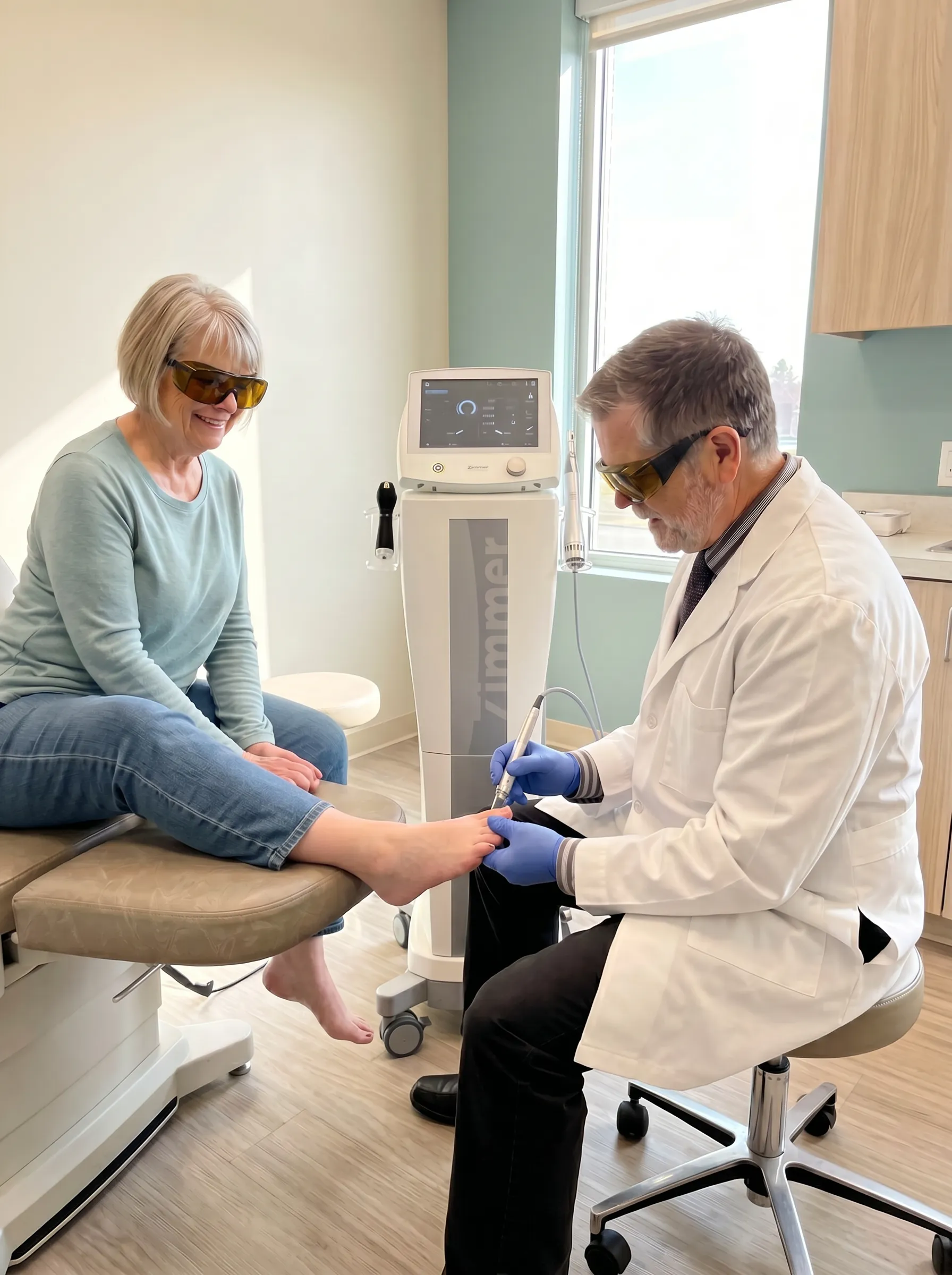
Dr. Frank J. Henry, DPM, FACFAS is a board-certified foot and ankle surgeon with more than 30 years of clinical experience and over 40,000 patients treated. He founded Marble Falls Podiatrist on a straightforward principle: the best surgeon is the one who keeps you out of the operating room. Roughly 95% of his patients resolve their foot and ankle conditions without surgery.
His approach to fungal nails reflects the same conservative philosophy. When other providers offer a single laser pass or a three-month course of oral antifungals with liver monitoring, Dr. Henry built a combined protocol that gets better results than either option alone — without the risk of systemic medication and without the disappointment of undertreatment.
What Happens at Your First Visit
Your first appointment is about two things: confirming the diagnosis and giving you an honest assessment of what a full protocol will look like for your specific nails. No pressure, no surprises.
-
1
History and goals
We talk through how long you’ve had the infection, what you’ve already tried, and what outcome matters most to you.
-
2
Clinical examination
Dr. Henry examines each affected nail, assesses the extent of the infection, and determines whether the nail bed and nail root are still healthy enough to respond to treatment.
-
3
Honest candidacy assessment
Not every patient is a candidate. If your nails are too far advanced for the laser protocol to give you a meaningful result, Dr. Henry will tell you directly — and explain what your realistic options are instead.
-
4
Your protocol plan, spoken aloud
If you’re a candidate, Dr. Henry walks you through what your specific three-session protocol will look like, the expected timeline to see clear nail growing in, and the total investment. You leave knowing exactly what to expect.
The first visit typically runs 30–45 minutes. Bring any over-the-counter products or medications you’ve been using — it helps us rule out contributing factors.
Common Questions About Laser Fungal Nail Treatment
Is the laser treatment painful?
No. The laser produces a warm sensation as it treats each nail — most patients describe it as comfortable and say it feels similar to sitting under a warm light. No needles, no anesthesia, no numbing required. You walk in, receive treatment, and walk out.
How long before I see clear nail growing in?
You’ll notice a dramatic improvement in appearance the same day as your first treatment. Once we’ve thinned the nails and removed the visible fungal debris, the nails look substantially better immediately — that’s the cosmetic win most patients aren’t expecting on day one.
The deeper measure of success is clear, healthy nail growing in from the root. Nails grow slowly — a healthy toenail takes roughly 9 to 12 months to grow from base to tip — so you’ll typically begin to see clear, healthy nail at the base of the treated toe within 8 to 12 weeks of starting the protocol, with continued clearance as the nail grows out. Full cosmetic resolution takes the better part of a year, which is why we encourage patients not to wait once they’ve decided to treat.
Can I wear nail polish during my protocol?
We strongly recommend keeping the nails bare throughout active treatment. Polish creates a dark, warm, moist environment — the exact conditions fungus thrives in. For special occasions, we allow Dr.’s Remedy antifungal nail polish, which contains tea tree oil and is formulated to breathe. Remove with a non-acetone remover; acetone damages the nail plate and undoes progress. Keep polish on only for the event, then remove it promptly.
I’ve had this for years — is it too late for me?
Often no, but honesty matters here. If your nail root is still generating healthy nail tissue, the laser protocol can clear the infection and allow a better-looking nail to grow in. If the nail root has been permanently damaged by years of untreated fungus, you may be left with some residual thickness or shape change even after the fungus is eliminated. Dr. Henry will give you an honest read on your specific situation at your first visit — and won’t start you on a protocol if the realistic outcome doesn’t justify the investment.
Why not just take the pill my doctor offered?
Oral antifungals can work — but peer-reviewed studies consistently show cure rates of only about 50 to 60 percent. Nearly half of patients take the medication, accept the risks, and still don’t get the result they were hoping for. Those risks aren’t minor: three months of your liver filtering a toxic medication, monthly blood tests to monitor for damage, and interactions with many common medications like statins and blood thinners. For most of our patients, a laser-based protocol delivers comparable or better results without putting the liver at risk — and without the gamble. If you and your doctor have decided oral medication is right for you, that’s a valid choice; our protocol is the non-systemic alternative.
Will it come back after treatment?
Fungal nails can recur if you’re re-exposed — fungus is everywhere, and some patients are more susceptible than others. We help you reduce recurrence risk significantly with a few practical steps: keep feet dry, rotate shoes so they dry fully between wears, wear open-toed shoes and get sunlight on bare feet when practical, and disinfect showers, bathtubs, and bathroom floors regularly with Lysol, diluted bleach, or a similar disinfectant. Patients who follow these habits after a successful protocol typically stay clear for years.
Does insurance cover this?
The laser protocol itself — the debridement, laser sessions, and prescription topical — is not covered. Insurance companies classify fungal nail laser treatment as a cosmetic procedure, so it’s a self-pay protocol.
The good news: your initial evaluation visit with Dr. Henry is billed to your insurance like any other podiatry consultation, and so are any follow-up visits where no laser treatment is performed. That means you can come in, be properly evaluated, hear Dr. Henry’s honest read on your specific case, and understand exactly what a full protocol would cost — all before committing to the self-pay portion. We’ll walk you through the numbers at that visit so there are no surprises.
Can my family members catch this from me?
Yes, though it requires close contact with surfaces where you’ve shed skin or nail particles — shared showers, bathtubs, and bathroom floors are the most common routes. Disinfecting those surfaces regularly (Lysol, diluted bleach, or similar) and not sharing towels, nail clippers, or footwear significantly reduces household spread. The best protection for your family is clearing your own infection.
Stop hiding your toenails.
Book your assessment with Dr. Henry and find out if you’re a candidate for our 3-step laser protocol.
Book Your Appointmentor call (830) 265-6000 to speak with our team directly
703 N US HWY 281, Suite 201 · Marble Falls, TX 78654 · Serving Marble Falls, Horseshoe Bay, Kingsland, Burnet, Llano, Lakeway, and the surrounding Highland Lakes area.