
Stand All Day Without Your Arches Giving Out by Three O’Clock
Advanced, Non-Surgical Treatment for Flat Feet, Fallen Arches, and Posterior Tibial Tendon Pain — Serving Marble Falls and the Highland Lakes
You know the feeling. By mid-afternoon, your arches ache deep and tired. The inside of your ankle has a dull, persistent burn. You’ve caught yourself watching your foot roll inward in a store window. You’ve sat down halfway through the garden. You’ve skipped the hike. You’ve started dreading the walk across the parking lot.
You don’t have to live with it. And in most cases, you don’t need reconstructive surgery to fix it.
Medicare and most major insurance plans accepted.

Dr. Henry on Arch Pain
Trusted by Patients Across the Highland Lakes
“I’d spent almost $1,800 at the Good Feet Store and my arch was still falling apart. Dr. Henry’s orthotics are a completely different animal — precise, medical, and they actually hold my arch up. I wish I’d come here first.”
— Denise R., Kingsland“Every doctor I saw treated me for a bad ankle. I went through a year of anti-inflammatories and a walking boot. Dr. Henry looked at me for fifteen minutes, did an ultrasound, and said, ‘That’s not your ankle — that’s your posterior tibial tendon.’ He was right. Finally getting better.”
— Carol P., Marble Falls“Worth the drive from Bee Cave. A surgeon in Austin had me scheduled for flat foot reconstruction in six weeks. Dr. Henry gave me an honest second opinion and a real non-surgical plan. I kept my ankle, and two years later I’m still hiking.”
— Margaret S., Bee CaveWhy Your Arch Keeps Collapsing
If You’ve Already Tried Inserts, Boots, or Cortisone — Here’s Why the Pain Came Back
A quick word before we get into why treatments fail: The most common thing new patients tell us is, “My ankle hurts.” They’re half right — it hurts on the inside of the ankle, which is exactly where the posterior tibial tendon runs. But the ankle joint itself is usually fine. It’s the tendon — overloaded, inflamed, and losing the fight against a collapsing arch — that’s generating the pain. Patients routinely spend months or years being treated for an “ankle problem” before anyone actually identifies the tendon. If that sounds familiar, you’re in the right place.
Your arch isn’t held up by bone. It’s held up by a single, overworked tendon — the posterior tibial tendon — running from deep in your calf down the inside of your ankle and under your arch. When that tendon is repeatedly overloaded without the right support, it stretches. When it stretches, the arch drops. When the arch drops, the tendon stretches more. This is Posterior Tibial Tendon Dysfunction (PTTD), also called Adult-Acquired Flat Foot — and it is, by definition, a progressive condition. It does not get better on its own.
Most patients who walk into our office have already tried something. There’s a reason none of it stopped the cycle.
- Over-the-counter arch supports and “custom” inserts from other clinics cushion but they don’t correct. Foam compresses the moment your body weight lands on it — giving out exactly when your arch needs it to push back.
- Walking boots and anti-inflammatories quiet the symptom while leaving the mechanical cause untouched. The moment you stop, the tendon overload returns.
- Cortisone shots directly into the posterior tibial tendon are a practice we approach with serious caution. Cortisone injected into a degenerating PTT can weaken the tendon further and, in some cases, precipitate rupture. A blind shot into a failing tendon is a decision worth thinking twice about.
And here’s what almost no one tells you: if adult-acquired flat foot is left alone long enough, the tendon stretches past the point of recovery, the arch collapses permanently, and the joints themselves start changing. The foot becomes stiff. Arthritis sets in. The arch that could have been rebuilt five years earlier with orthotics and conservative care becomes a rigid, arthritic foot where reconstructive surgery — often joint fusion — is the only remaining option. That’s the stage we work hardest to prevent. And it is preventable, if we catch you in time.
Why the Insert From the Good Feet Store — or From Most Clinics — Isn’t Holding Your Arch Up
If you’ve already spent hundreds (or even thousands) at the Good Feet Store or a similar retailer, here’s the clinical reason it hasn’t stopped your arch from collapsing.
We want to be clear up front: that’s not your fault. Products sold at walk-in arch-support stores are comfort aids, not medical orthotics. They’re pre-made, sold in a retail setting, and not prescribed based on your specific mechanics. They feel supportive at first because they’re firm — but firm and mechanically correct are not the same thing.
The “Weight-Bearing” Flaw: Most retail brands — and even many medical providers — take molds or scans of your feet while you are standing up. For a collapsing arch, that is a fundamental engineering mistake.
- ✗ Molding the Collapse: When you stand, your arch drops into the exact position that’s causing your pain. Mold a foot while it’s collapsed and you get a device that holds you in that damaging, uncorrected position. It’s a souvenir of the problem, not a solution for it.
- ✓ The Marble Falls Difference: We capture your foot in its optimal, corrected skeletal position — not its collapsed one. The posting, rigidity, and support are prescribed based on your gait, your weight, your shoe type, and the activity you’re trying to get back to. Built once, adjusted periodically in our office, and routinely lasting fifteen to twenty years with tune-ups. For many of our patients, the orthotic we build them is the last one they’ll ever need to buy.
Compared to spending that money every couple of years on a product that isn’t solving the underlying problem, a true medical orthotic is — honestly — the most conservative financial choice you can make for your arch.
A Complete Approach to Rebuilding Your Arch — Without Surgery
A collapsing arch has three problems that have to be solved at the same time. Solve one, skip the others, and you’ll be back in our office in six months.
1. The Blueprint
Precision Custom Orthotics: You cannot rebuild a tendon on a collapsing foundation. Following a full biomechanical evaluation, we engineer prescription orthotics designed to precisely realign your skeletal system in its corrected position — stopping, not just softening, the shearing forces tearing your posterior tibial tendon down. Routinely lasting 15–20 years with periodic adjustments. This is the foundation. Everything else is built on it.
2. The Signaling
Restorative Interventions: A chronically overloaded tendon eventually stops trying to heal itself. The repair signal goes quiet. We deliver a concentrated signaling command directly to the damaged tissue using Extracorporeal Shockwave Therapy to wake the tendon back up and Class IV Laser Therapy to reduce inflammation and support repair at the cellular level. These do something medication can’t: they get your body to finish a job it gave up on years ago.
3. Specialized Tools
Ultrasound-Guided Precision: We use diagnostic musculoskeletal ultrasound to look directly at your posterior tibial tendon — not guess at it. We see exactly where it’s thickened, split, or fluid-filled. That precision lets us deliver advanced restorative injection therapy exactly where it matters, under live ultrasound guidance — never blind, never “around the general area.”
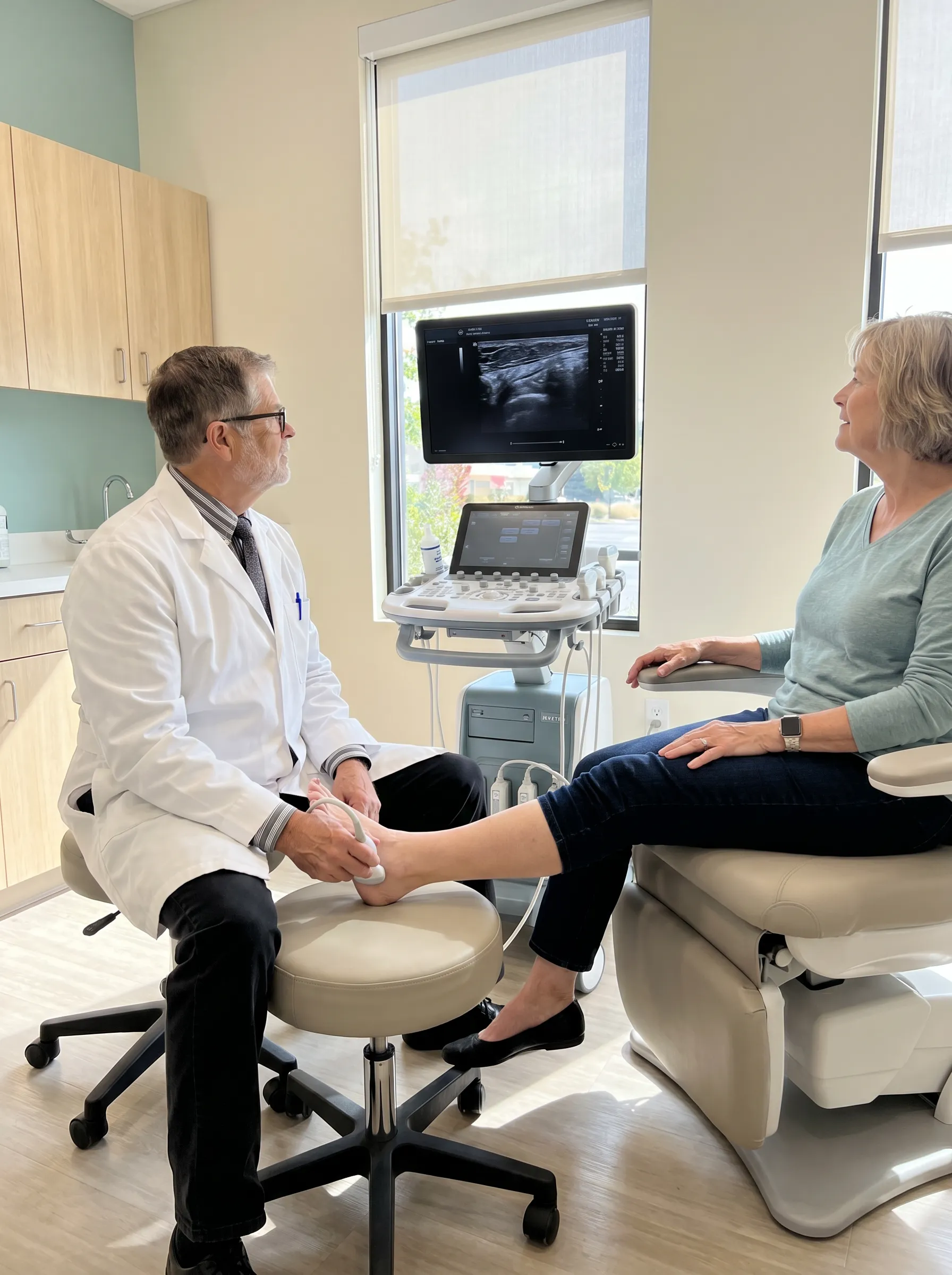
Meet Dr. Frank J. Henry DPM, FACFAS
“Adult-acquired flat foot is the condition I most wish patients found us earlier. A posterior tibial tendon we can rebuild today becomes, five or ten years later, a foot so rigid and arthritic that surgery stops being a choice — it becomes the only remaining option. The window to prevent that is real, and it’s wider than most patients are told. We just have to step into it before it closes.”
Dr. Frank Henry DPM is a board-certified Foot and Ankle Surgeon and a Fellow of the American College of Foot and Ankle Surgeons. Over more than 30 years of practice and 40,000 patients treated, he maintains a 95% surgery avoidance rate.
Today, Dr. Henry uses his extensive surgical background to do the opposite of what many specialists do — he keeps patients out of the operating room. You’ll never feel rushed in his office. You’ll get a real evaluation, a real explanation, and a real plan.
What to Expect at Your First Visit
We know how frustrating rushed, ten-minute medical appointments can be. Your first visit with us is different.
- A thorough, unhurried evaluation. We sit down with you, listen carefully to your history, and take the time to understand exactly how the arch pain is affecting your daily life — the hikes you’ve stopped taking, the trips you’ve talked yourself out of, the activities you’ve quietly let go.
- A complete biomechanical assessment. Your arch doesn’t collapse in isolation. We examine your foot, your ankle, your gait, and your kinetic chain — because your knee alignment, your hip, and your walking pattern are all part of the equation.
- Instant diagnostic clarity. In-office digital weight-bearing X-rays and live musculoskeletal ultrasound are completed and reviewed with you right there in the exam room — images up on the screen, walked through in real time. No waiting days for a radiologist’s report.
- A diagnostic orthopedic taping test. We apply a therapeutic strap to your foot and have you walk on it. This isn’t the treatment — it’s a predictive test. How your pain responds to the mechanical correction is one of the most reliable signals we have for how your body will respond to the full protocol. Even modest relief with the tape is a strong predictor of substantial improvement ahead. The tape itself is short-lived and diagnostic by design — a snapshot, not the destination. The lasting resolution comes from the protocol working together.
- A clear plan and honest pricing — before any treatment begins. We outline your options at your first visit. At your follow-up, we review how your foot responded to the tape test, walk you through your exact treatment plan, and give you a complete breakdown of costs. You’ll never be asked to commit to treatment without knowing what it involves or what it costs.
- Honest answers about whether surgery is or isn’t on the table. In the rare case it is, you’ll know why. In the much more common case it isn’t, you’ll know that too.
Common Questions About Arch Pain & Flat Feet
I’ve always had flat feet and they’ve never bothered me. Why does my arch hurt now?
Adult-acquired flat foot is not the same thing as having been born with low arches. Some people live comfortably on low arches their whole lives — that’s a structural variant, not a problem. What you’re describing is different: a progressive tendon failure where an arch that used to function is now collapsing under its own mechanics, usually with pain on the inside of the ankle. The treatment is completely different. One is a lifestyle consideration; the other is a condition that needs active intervention before it advances.
My ankle hurts, not my arch. Does this page even apply to me?
Possibly yes — and this is one of the most common reasons patients end up with us after months of being treated for the wrong thing. The posterior tibial tendon runs down the inside of your ankle and into your arch. When it’s inflamed or failing, the pain is felt on the inside of the ankle long before the arch visibly drops. If you’ve been told you have an “ankle problem” but standard ankle treatments aren’t working, it’s worth being evaluated for PTTD specifically.
I was told I need a cortisone shot into my posterior tibial tendon. Is that a good idea?
We are deliberately cautious about this. Cortisone injected directly into a degenerating posterior tibial tendon can weaken the tendon further and, in some cases, precipitate rupture. There are situations where a carefully placed, ultrasound-guided corticosteroid injection around (not into) the tendon sheath may be appropriate — but a blind shot directly into a tendon that’s already failing is a decision worth thinking twice about.
A podiatrist in Austin told me I need flat foot reconstruction. Do I need a second opinion?
Yes — and this is precisely the patient population we built this practice for. A meaningful percentage of patients who are told they need flat foot reconstruction are still candidates for non-surgical stabilization, particularly if they haven’t yet had a legitimate trial of precision orthotics, shockwave, and targeted tendon-focused care. A second opinion costs you an appointment and an afternoon. Flat foot reconstruction costs you months of recovery and permanently altered mechanics. The math isn’t close.
What happens if I just keep living with it?
Adult-acquired flat foot is a progressive condition — it gets worse over time, not better. In the early stages, the tendon is stretched but still responsive to conservative care. In middle stages, arch collapse accelerates wear on surrounding joints. In late stages, the foot becomes stiff and arthritic, and the joints themselves develop arthritis severe enough that reconstructive surgery — often joint fusion — becomes the only remaining option. The earlier we intervene, the more of your natural foot we preserve.
How long before I feel better?
Most patients notice reduced arch fatigue within the first few weeks of wearing properly prescribed orthotics. Tendon remodeling with shockwave and supportive care typically shows meaningful improvement over 6 to 12 weeks, with continued strengthening in the months that follow. Adult-acquired flat foot isn’t an overnight fix — but it is a condition that responds beautifully to the right protocol applied consistently.
Do you accept Medicare and insurance?
Yes. We accept Medicare and most major insurance plans. Our team is happy to verify your benefits before your first appointment — just call (830) 265-6000.