
Dr. Frank J. Henry, DPM, FACFAS
Board-Certified Foot and Ankle Surgeon — Practicing Conservative Podiatry in Marble Falls and the Texas Hill Country
Dr. Frank J. Henry has practiced podiatric medicine since 1980. He has been board-certified in foot and ankle surgery by the American Board of Foot and Ankle Surgery since 1990 — with full unrestricted scope across the forefoot, rearfoot, and ankle. In over forty years of clinical practice, he has built a reputation for one specific thing: keeping the great majority of his patients out of the operating room without compromising the quality of their care.
Medicare and most major insurance plans accepted.
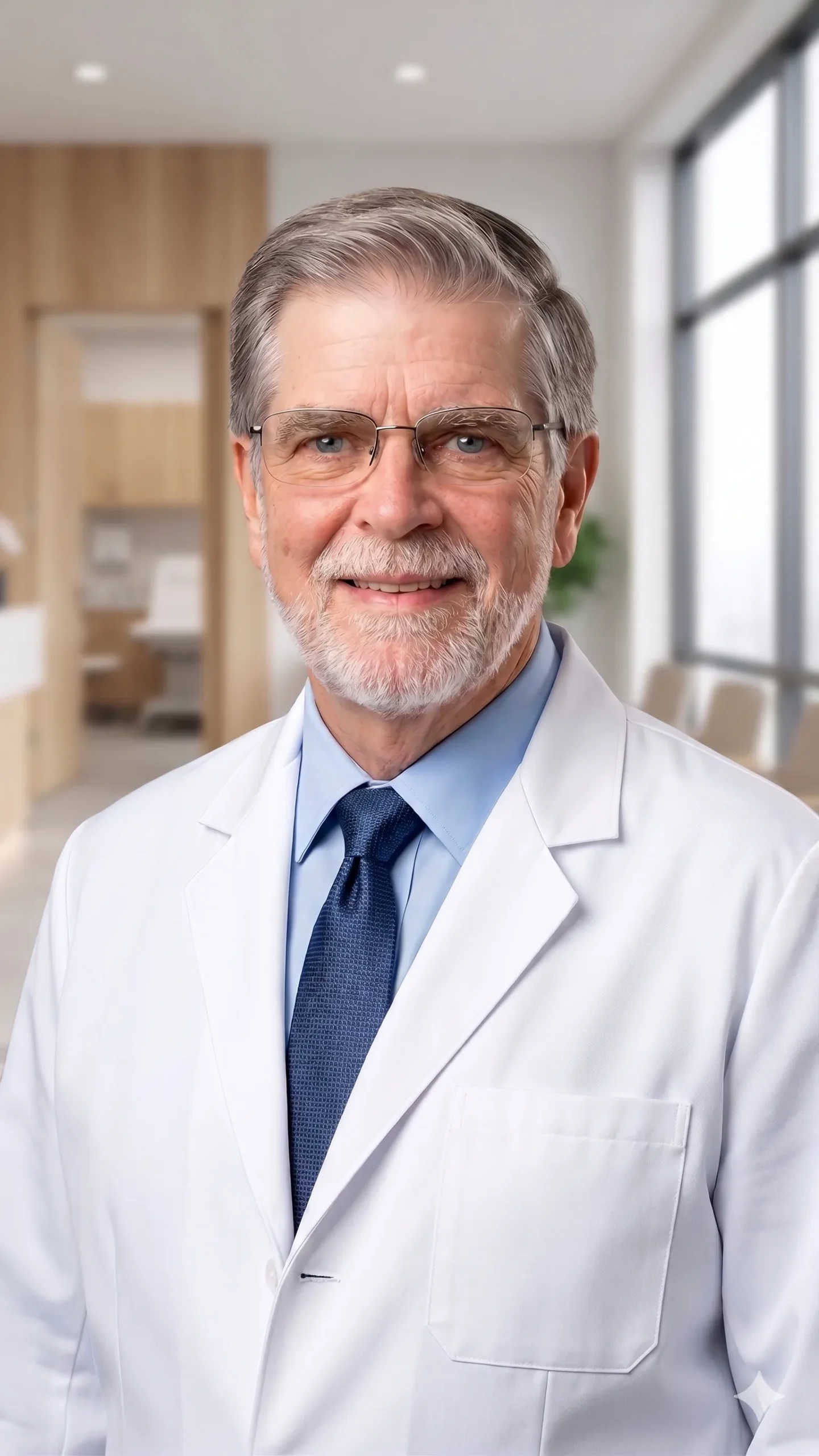
Meet Dr. Frank Henry
Credentials & Training
Education
Dr. Henry completed his Bachelor of Science at Kansas State University and his Doctor of Podiatric Medicine at the California College of Podiatric Medicine in San Francisco (now affiliated with Samuel Merritt University).
Lineage in Foot and Ankle Biomechanics
During and after his medical training, Dr. Henry studied biomechanics directly under Drs. Root, Weed, Orien, and Sgarlato — the founders of the modern field of foot and ankle biomechanics. He has continued to refine his clinical approach through ongoing study with the leading practitioners and pathfinders of the modern era, including Drs. Richard Blake, Larry Huppin, Paul Scherer, Kevin Kirby, and Doug Richie. The result is a clinical practice grounded in the foundational principles of the field and continually updated by the work of those who have advanced it.
Board Certification — Full Unrestricted Scope
Dr. Henry is a Diplomate of the American Board of Foot and Ankle Surgery (ABFAS), holding the full unrestricted scope of certification — forefoot, rearfoot, and ankle. This is the most comprehensive surgical certification available in podiatric medicine and is held by a relatively small percentage of practicing podiatrists. He is also a Diplomate of the American Board of Podiatric Examiners.
Fellowships and Professional Memberships
- Fellow, American College of Foot and Ankle Surgeons (FACFAS) — full surgical scope
- Fellow, American College of Podiatric Medicine
- Fellow, American College of Podiatric Orthopedics and Medicine
- Member, American Podiatric Medical Association
- Member, Texas Podiatric Medical Association
- Peer Review Committee Member, Texas Podiatric Medical Association
Teaching, Lecturing, and International Service
Dr. Henry has lectured nationally on the diagnosis and treatment of heel pain and other foot and ankle conditions, with particular focus on patient-centered injection technique and biomechanical assessment. He has served as a visiting podiatric surgeon at the American Children’s Hospital in Kraków, Poland and at the London Foot Hospital and College of Podiatry in London, England.
A Career of Firsts
Dr. Henry has consistently been an early adopter of new diagnostic and treatment technology in podiatry, frequently introducing tools to South Texas a decade or more ahead of widespread adoption in the field. Among his firsts: in-office therapeutic laser (1985); musculoskeletal ultrasonography in clinical practice (August 2000), at a time when ultrasound was rarely used in podiatric offices anywhere in the country; and an early adopter of advanced restorative injection therapies (2007) and tissue-based healing techniques (2013), well ahead of when these approaches became standard in the field. He has also brought digital weight-bearing X-ray, computerized gait analysis, and computer-milled digital orthotic fabrication to the region as those technologies emerged.
A Combination Rarely Found in One Practitioner
There are excellent foot and ankle surgeons. There are excellent biomechanical specialists. The two skill sets are typically held by different people, in different practices, addressing different problems. Dr. Henry’s clinical work brings them together — the diagnostic depth and surgical credentialing of a board-certified foot and ankle surgeon, combined with the biomechanical training of a Root-school clinician, refined over more than four decades of practice. It is the combination, more than any single credential, that defines how he treats patients today.
Why I Practice This Way
Early in my career, I trained as a surgeon. I learned to operate on plantar fasciitis. I learned to operate on foot and ankle arthritis. I fixed bunions. I fixed hammertoes. I did the procedures, and I did them well.
But somewhere along the way, I started noticing something. Patients would come into my practice — patients who’d had surgery elsewhere — and they were no better than they’d been before the operation. Sometimes they were worse. And when I went back through their charts and asked them what they’d tried before the surgery, the story was almost always the same. Their operating surgeon had told them to try a pair of arch supports from the pharmacy, or to switch shoes, or to rest and ice for a few weeks. When that didn’t help — which it rarely does — the surgery was scheduled.
The “conservative care has failed” box had been checked. But conservative care had never actually been tried.
So I’d build these patients real orthotics — properly engineered, biomechanically prescribed devices, the kind their feet had needed all along — and the great majority of them got better. Pain that surgery hadn’t resolved finally resolved. Function that surgery hadn’t restored finally returned. And I would think the same thing, every single time: if this patient had been given real orthotics and real conservative care first, they would never have needed the surgery in the first place.
That observation, repeated thousands of times over more than three decades, is the reason I practice the way I do today. I am a foot and ankle surgeon who can perform any procedure my training qualifies me for — and in the great majority of cases, I choose not to. The math is straightforward: do the conservative care that actually works, and most patients never need the operating room at all.
About Surgery
Most people deeply want surgery to be a magic bullet. The procedure happens, you wake up fixed, you go home better. That’s the story we want to be true.
It isn’t always.
Surgery results can be disappointing. Surgery can make any given condition worse than it was before. And when that happens, the answer is rarely more surgery — because the problem with operating on something you didn’t fully understand the first time is that you typically don’t understand it any better the second time either.
Even simple foot surgery carries real risk. Anesthesia complications. Infection. Wound healing problems that drag on for months. Blood clots that travel from the leg to the lung — those can kill you. Strokes during or after the procedure that leave patients with lifelong disability. Catastrophic stump neuromas after nerve surgery — a chronic pain syndrome far worse than the original problem, with no reliable cure. In rare cases, patients die from elective foot surgery. They are rare. But they happen. You don’t want to be that patient. You don’t want your spouse or your parent or your grandchild to be that patient either.
The hardest part of all of this isn’t the risk itself. It’s the irreversibility. You can’t return a failed foot surgery for an exchange. Whatever they take out, they can’t put back. Whatever they cut, they can’t un-cut. Whatever scar tissue forms in the months after the operation will be there for the rest of your life.
That’s why I take so seriously the question of whether a patient genuinely needs surgery. It’s why I won’t recommend it for someone who hasn’t first had a real, expert, sustained attempt at non-surgical resolution. And it’s why, when surgery genuinely is the right answer, I tell you that directly — and refer you to a surgeon I trust.
“What I tell my patients is this: do the orthotics that are needed after the surgery — FIRST — and you can skip the surgery altogether.”
— Dr. Frank J. Henry, DPM, FACFASOutside the Office
Dr. Henry lives in the Marble Falls / Kingsland area on Lake LBJ. He is married to Tess Henry, a licensed Texas real estate agent specializing in the Lake LBJ waterfront market. Together they are the proud parents of six children — Andy, Zak, Christina, Austin, Matthew, and Scarlett — and the very proud grandparents of four grandchildren: Carter, Jane, Elyse, and Ella Grace.
He spent many years in volunteer service with the United States Coast Guard Auxiliary, holding leadership positions including Flotilla Commander, Division Captain for Southern Texas, and Rear Commodore West for the 8th District covering Texas and New Mexico. He received multiple citations for meritorious service. He has also served as a Cub Scout and Boy Scout leader, and is the proud father of two Eagle Scouts.
Dr. and Tess Henry are members of Austin Ridge Bible Church in Marble Falls. He credits his faith with shaping how he listens to and cares for his patients — with patience, honesty, and respect for the person in front of him.
When he isn’t in the clinic, Dr. Henry can usually be found kayaking on Lake LBJ and tending to his ranch outside of Burnet, often with Lucy, the family dachshund — a determined little dog who once succeeded in catching a deer in the Henry yard. He plays piano, has dabbled with harmonica and accordion, and is a serious student of history.
A Personal Note
Dr. Henry’s commitment to conservative care also has personal roots. He has, himself, used the same prescription orthotics he builds for his patients to overcome significant weight gain, knee pain, and early posterior tibial tendon dysfunction — eventually losing ninety pounds and returning to running five miles a day in the same kind of stability shoes he prescribes. He understands, from his own experience, that the right orthotics aren’t simply a treatment for foot pain. They are sometimes the thing that gives a patient back their ability to live.
What Our Patients Say
“I had been to so many doctors who barely looked up from their charts. Dr. Henry sat down across from me, looked me in the eye, and asked me to tell him exactly what was happening. He spent more time on my first visit than my own primary care physician had given me in five years. By the time I left, I knew he understood what was wrong — and I trusted him to fix it.”
— Patricia W., Burnet“My orthopedic surgeon had me scheduled for foot surgery in three weeks. My daughter convinced me to get a second opinion, and I came to Dr. Henry. He looked at my X-rays, examined me carefully, and told me — straight out — that he didn’t think I needed the surgery. He laid out a different plan instead. Eight months later I’m walking pain-free. I never had the surgery.”
— Robert L., Spicewood“Dr. Henry has a way of explaining what’s wrong with your foot that makes it actually make sense. He showed me the problem on the ultrasound. He explained why my old shoes had been making it worse. He answered every question I had — and I had a lot of them. I left the office understanding my own body better than I had in years.”
— Linda H., Granite ShoalsCommon Questions About Dr. Henry
How long has Dr. Henry been practicing podiatric medicine?
Dr. Henry has practiced since 1980. He has been board-certified in foot and ankle surgery by the American Board of Foot and Ankle Surgery since 1990. Over more than four decades of practice, he has personally treated more than 40,000 patients across Central and South Texas.
Where did Dr. Henry train?
Dr. Henry holds a Bachelor of Science from Kansas State University and a Doctor of Podiatric Medicine from the California College of Podiatric Medicine in San Francisco (now affiliated with Samuel Merritt University). He studied biomechanics directly under Drs. Root, Weed, Orien, and Sgarlato, the founders of modern foot and ankle biomechanics, and continues ongoing study with the leading current-day practitioners in the field.
What is Dr. Henry’s surgical certification scope?
Dr. Henry holds the full unrestricted scope of foot and ankle surgical certification — forefoot, rearfoot, and ankle — through the American Board of Foot and Ankle Surgery. This is the most comprehensive surgical certification available in podiatric medicine and is held by a relatively small percentage of practicing podiatrists.
Does Dr. Henry still perform surgery?
Dr. Henry remains fully credentialed and qualified to perform the entire scope of foot and ankle surgery. His current clinical practice in Marble Falls is focused on conservative, non-surgical care, where he keeps approximately 95% of his patients out of the operating room. When surgery is genuinely the right answer for a patient, he refers them to surgical colleagues he trusts personally and continues to oversee their care.
Can I request to see Dr. Henry specifically?
Yes. Dr. Henry sees every patient personally. There are no associate physicians or physician assistants delivering care under his name — when you book an appointment with the practice, you are scheduling time with Dr. Henry himself.