
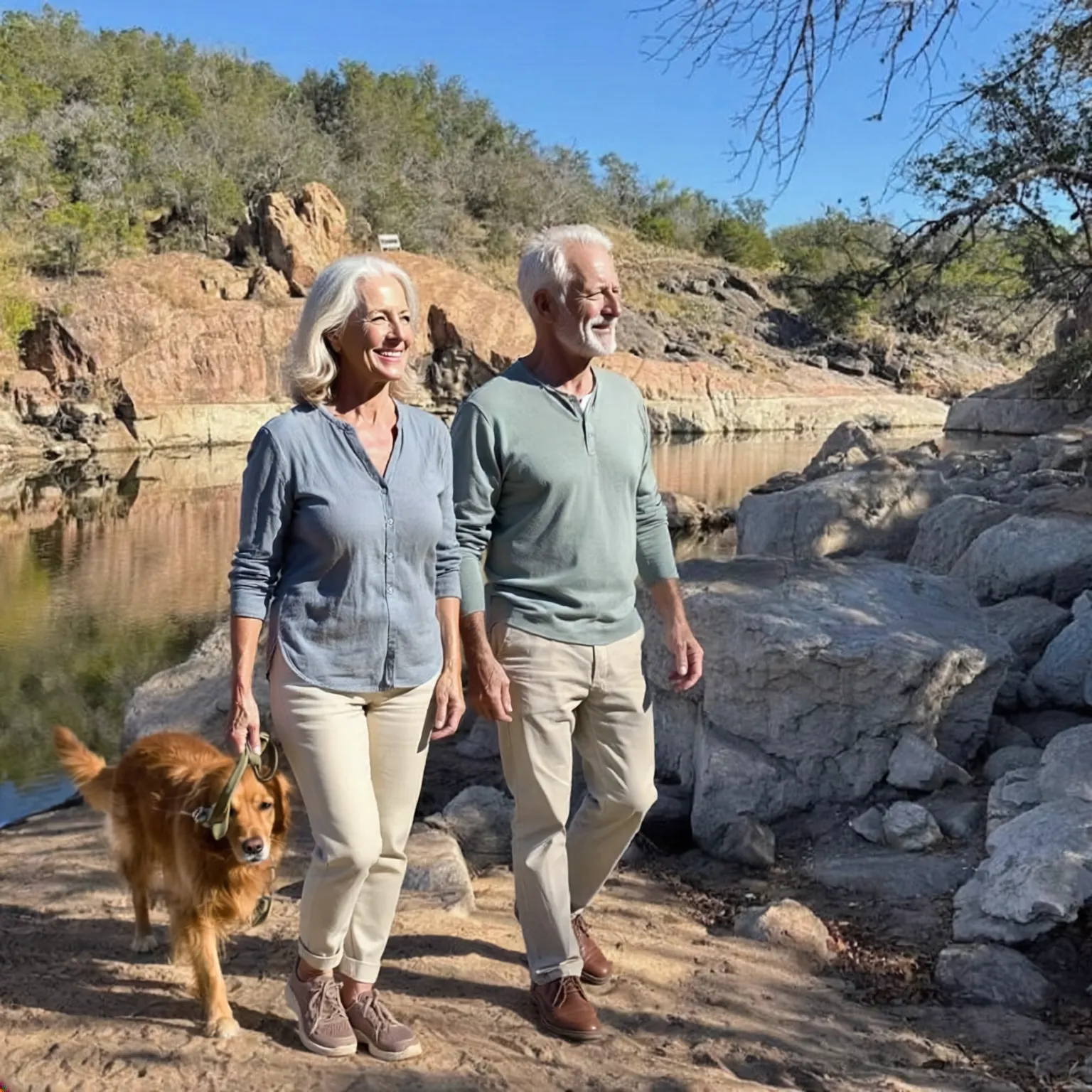
Hill Country Hiking After 65: How to Keep Your Feet Going
Hiking is one of the great gifts of living in the Texas Hill Country. The Pennybacker Bridge overlook, the Inks Lake trails, the Enchanted Rock summit, the Reveille Peak ranch, the Colorado Bend State Park waterfalls, the loop trails around Marble Falls and the Highland Lakes — there’s no shortage of beautiful country within an hour’s drive.
For active adults over 65, hiking is one of the best things you can do for your overall health. Cardiovascular conditioning, balance, strength, bone density, mental clarity — the benefits compound year after year.
But the feet take the brunt of it. And small foot problems that you might shrug off in your 40s become legitimate barriers to hiking in your 60s, 70s, and beyond.
I’ve spent 30+ years as a board-certified foot and ankle surgeon, with more than 40,000 patients treated at Marble Falls Podiatrist. Many of my patients are active hikers who refuse to slow down — and the protocols we use are built around keeping them on the trails. Here’s the practical foot-care guide for Hill Country hikers over 65.
What the Hill Country does to your feet
Hill Country trails are a particular type of demanding. The terrain combines limestone, granite, decomposed granite gravel, root and rock obstacles, and sudden elevation changes. The mix of surface types means your foot is constantly adapting — supinating on uneven ground, pronating on impact, gripping on descents, pushing off on climbs.
Add the Texas heat for half the year, and your feet are also dealing with sweat, friction, and the swelling that comes with sustained heat exposure.
The most common hiking-related foot problems we see in active adults over 65:
- Plantar fasciitis flares. Long days on uneven ground reawaken old plantar fascia issues — or expose new ones.
- Achilles tendinopathy. Climbs in particular load the Achilles. Repeated long hikes without adequate recovery can tip a tendon into chronic irritation.
- Foot and ankle arthritis flares. Hikers with hallux rigidus, midfoot arthritis, or ankle arthritis often feel their joints “lock up” the day after a long descent.
- Blisters and skin breakdown. Heat, sweat, and friction in long-mileage days.
- Toenail trauma. Repeated downhill walking pushes the toes into the front of the boot, bruising or lifting nails.
- Ankle sprains. Even experienced hikers roll ankles on Hill Country trails. The risk increases with age as proprioception and reaction time naturally decline.
- Stress fractures. Particularly in patients who increased their hiking volume too quickly.
The good news: all of these are largely preventable, and the conditions that do develop respond well to early conservative care.
The foundation — footwear
The single most important variable in keeping your feet hiking-ready is footwear. Specifically:
- Hiking shoes or boots — not running shoes. Hiking footwear is built with the lateral stability and toe protection running shoes don’t have.
- Appropriate ankle support for your stability needs. Patients with weak ankles or a history of sprains often do well in mid-cut or high-cut boots. Stronger ankles can manage trail runners or low-cut hikers.
- Properly sized. Feet expand on long hikes from heat and sustained loading. Many hikers find their best fit is a half-size larger than their normal shoe.
- Broken in before any long hike. New boots on a 6-mile loop is asking for trouble.
- Compatible with your orthotics. If you wear custom medical orthotics — and most active adults over 65 benefit from them — the boots need to accommodate them with adequate depth.
Why custom medical orthotics matter more after 65
The foot loses some of its natural shock absorption and arch support as we age. The fat pad on the bottom of the heel thins. Ligaments relax. Joint cartilage thins. Foot mechanics that were neutral in your 40s often shift toward overpronation, splaying, or partial collapse by your 60s and 70s.
A custom medical orthotic compensates for these changes. It supports the arch where it’s no longer self-supporting. It redistributes load away from joints that are starting to wear. It absorbs impact the fat pad no longer fully provides.
For hikers over 65, the difference between hiking in custom orthotics versus standard shoe inserts is often the difference between still hiking comfortably and giving the sport up. We’ve seen patients who’d resigned themselves to short walks return to genuine trail hiking after getting properly fitted orthotics and addressing whatever mechanical issue had been quietly worsening.
This is also why over-the-counter inserts and Good Feet Store products usually disappoint here — they’re not engineered for your specific foot mechanics, and they wear out faster than the medical-grade alternative.
Conditioning matters more than mileage
A common pattern we see: a Hill Country hiker pushes for one big hike — Enchanted Rock summit, a long Colorado Bend loop — without adequate conditioning. The plantar fascia, Achilles, or a specific joint takes the hit. Weeks of recovery follow.
Better approach:
- Build mileage gradually. Long, easy walks before challenging trails.
- Cross-train. Cycling, swimming, and strength training maintain fitness with less foot impact.
- Strengthen the calf and Achilles complex. Eccentric calf raises — slow controlled lowering — protect the Achilles and the foot’s push-off mechanics. Most patients can do these at home.
- Maintain ankle stability. Single-leg balance exercises, in safe conditions, preserve the proprioception that protects against sprains.
- Recover deliberately. A day off after a long hike isn’t weakness; it’s how the tissue rebuilds.
When to come in versus push through
Most hiking-related foot issues respond to early conservative care. The patients who get sidelined are usually the ones who waited too long.
Come in when you notice:
- Heel pain that persists more than a couple of weeks
- Achilles stiffness that isn’t resolving with rest
- Joint pain — big toe, midfoot, or ankle — that lingers after a hike
- Repeated ankle rolls, even minor ones
- A sudden onset of foot pain without a specific injury moment
- Toenail problems that aren’t growing out cleanly
- Numbness, burning, or tingling that’s new
We treat heel pain, Achilles tendonitis, and foot and ankle arthritis using durable conservative protocols adapted to your specific conditioning, goals, and hiking ambitions. You can also review the full range of foot and ankle conditions we treat.
What an evaluation looks like
A first visit at Marble Falls Podiatrist takes about an hour and includes a full history and goals review (including your hiking volume and ambitions), biomechanical evaluation, in-office digital X-rays reviewed with you on-screen, diagnostic ultrasound where soft-tissue involvement is suspected, an orthopedic strapping/taping test that predicts how well a custom orthotic and the full protocol will perform, and an honest, spoken-out-loud assessment.
You leave with a complete picture of your options and the time to make the decision that’s right for you.
We see hiking and active-lifestyle patients from across the Highland Lakes and Hill Country, including Marble Falls, Burnet, Kingsland, Horseshoe Bay, Granite Shoals, Llano, Lakeway, Bee Cave, Spicewood, Dripping Springs, and the surrounding Austin area.
The bottom line
The patients in our practice who are still hiking the Hill Country in their 70s and 80s aren’t doing it on luck. They’re doing it on good footwear, custom medical orthotics, consistent conditioning, early intervention when something starts to ache, and a podiatric partner who understands the lifestyle they want to maintain.
You don’t have to give up the trails. And small foot problems are almost always easier to fix than postponed ones.
Schedule a Foot Pain Evaluation
Book Your Foot Evaluationor call (830) 265-6000 to speak with our team directly.